Women in the Odyssey
The epics are considered the product of a long oral tradition, which was shaped time and again through performances, bards, and their audiences.
Within this tradition, women may have played a much greater role than we had assumed.
The identity of the author of the *Iliad* and the *Odyssey* remains one of the greatest unsolved mysteries, the so-called “Homeric Question.” We do not know if it was one person or many; we do not know their origin; we cannot even say with complete certainty what their gender was.
But looking back at human history, we often find
—That from grandmother to mother and from mother to daughter. We say “grandmother’s fairy tales,” never “grandfather’s fairy tales.” The mythical aspect has been shouldered by the grandmother, just as she has shouldered tradition. Tradition literally means “to hand down.”
The Homeric epics remind us that they were experienced exactly this way: in a folk tradition, chanted at tables and in the streets for centuries, before the text was “captured” by literary convention. The rhapsodes who recited them were most likely men. But the folk life of a work—its transmission from generation to generation—has historically, very often, passed through women. The songs of that world were not necessarily sung by free women. “The foundation of that world is based on slavery. The women in the princess’s court were often highly educated, but they belonged to the princess.”
A text so fluid, so collective, has room for many hands. Why not women’s as well?
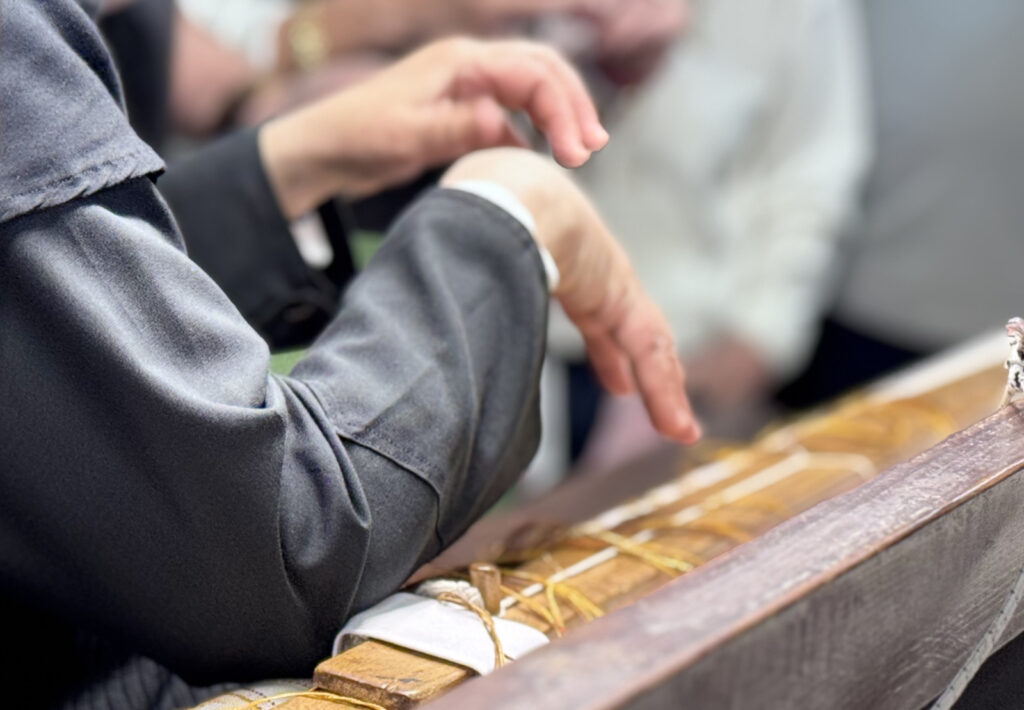
A large part of the epics, she observes, describes work: they slaughter, skin, skewer, weave, and build ships. And this work has gendered characteristics.
The descriptions of embroidery and needlework are much more detailed, much more precise, than Odysseus’s shipbuilding and repair work. It would be reasonable to expect an aristocratic man to be more knowledgeable about seafaring and the art of war than about embroidery. “So we have an indication of a female subjectivity behind the text.”
This is not proof, since the Homeric question “has not been resolved and will never be resolved.” Homer describes the Bronze Age, four centuries before his own time, and equips his heroes with iron weapons. “If you look at the weapons from Agamemnon’s era at the Archaeological Museum, they aren’t made of iron.”
A text so fluid, so collective, has room for many hands. Why not women’s hands as well?
“The singer shapes tradition”
–
“The women’s tradition of lamenting the dead significantly influenced the Homeric epics and was incorporated into them”
. Briseis, Andromache, Hecuba, and Helen lament in the *Iliad*. The women’s speech throughout the epics reflects the language of lamentation. And in the *Odyssey*, he explains, Penelope, upon learning in Book D that Telemachus has secretly left Ithaca, mourns both for her son, fearing what might befall him, and for her husband, whose fate—whether alive or dead—remains unknown.
Women are not absent from the epics. Their voices are woven into the very fabric of the epics themselves, from the laments to, perhaps, the hands that passed them down from generation to generation.
“Discussions about the status of women in Homer’s time are conducted in an anachronistic manner, and this is not only politically incorrect; above all, it is epistemologically incorrect.”
**It is precisely this scholarly perspective that restores the work to its true dimensions, far from superficial interpretations. “This is the anthropological perspective: that we situate the literary phenomenon within today’s society, within the society to which it pertains, because Homer pertains to us, not to his own era. We are talking right now on the phone about a person—or many people—who wrote something 2,800 years ago. This is astonishing; it concerns us. But the terms on which it concerns us are the terms of his own era.”**